
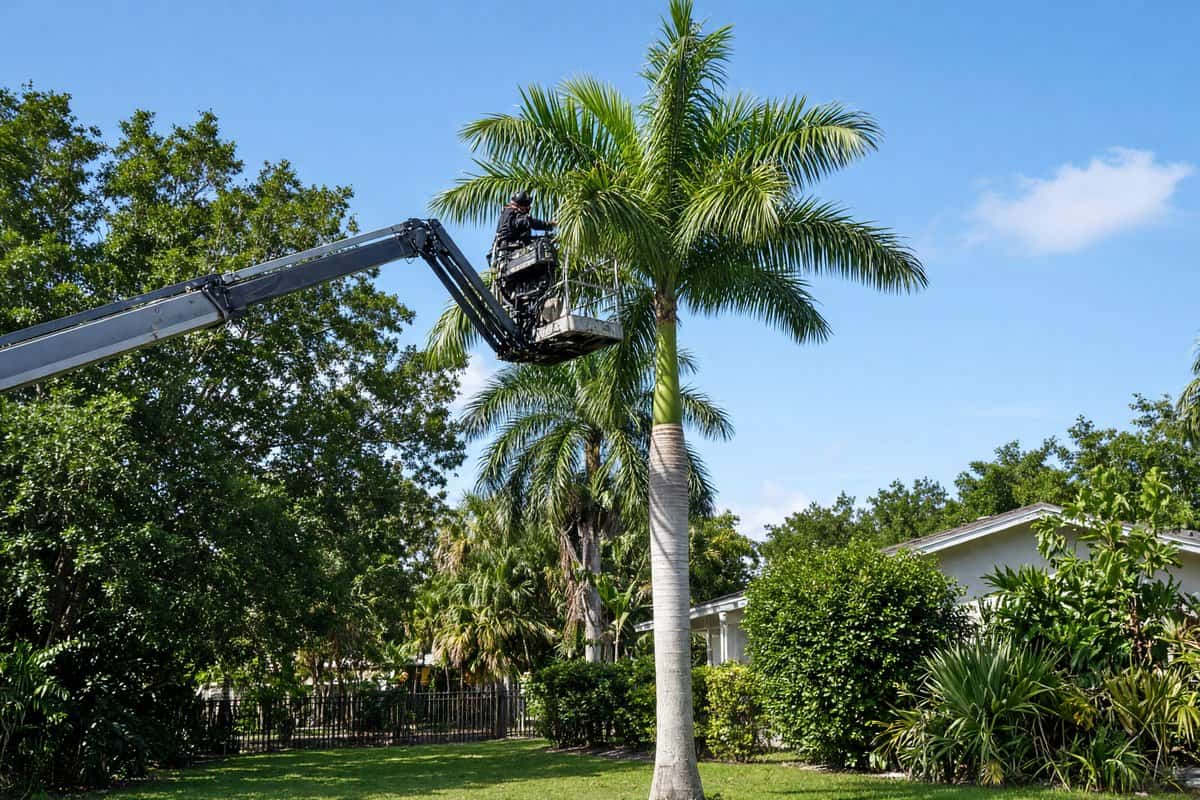
South Florida palms are not oversized houseplants. They are structural plants with one growing point, and a bad trim job can set them back for years. KAP Tree Service handles tree trimming in Davie, FL and the neighboring Broward cities, including the royal, sabal, queen, coconut, and foxtail palms that line most of these yards.
Call (754) 291-6477 for a free estimate
The palms we actually see on Broward lots
Royal palms are the tall, smooth-trunk trees along older boulevards and larger homes. They drop a heavy crown shaft. When that boot hangs and dries, it can come down in one piece. Trimming here is about removing dead material and spent flower/fruit stalks, not carving the crown into a pineapple.
Sabal (cabbage) palms are native, tough, and slower. They hold old boots on the trunk for a long time. You can clean them for a neater look, but stripping every boot off a sabal is cosmetic, not required for the health of the tree.
Queen palms are the ones that collect hanging fruit strings and look messy after a wet spring. They are also the ones people over-trim because the canopy looks “full.” Leave the healthy green fronds. Take the brown ones and the fruit.
Coconut palms are a different job because of the nuts. A mature coconut is a hard, heavy fruit. Over a driveway, a pool cage, or a walkway, those nuts are the hazard, not the fronds. De-nutting is the work most homeowners actually need.
Foxtail palms put out a plumose head that people like to shape. Same rule: do not cut into the green to make a smaller ball. You will starve the palm.
Bismarck, date, and areca show up too. The species changes the look. It does not change the rule: protect the bud in the center of the crown.
When to trim in South Florida
Palms here grow year-round. There is no true dormant season the way a northern oak has one. The practical window is when you can see what is dead, and when you can get the fruit off before storm season.
Late spring through early summer is when queen and coconut fruit hang heavy. That is a good time to clean them so you are not looking at a load of nuts in August. After a cold snap, wait and see which fronds actually die before you cut; some bronzing on a royal or Bismarck is weather, not a dead frond.
If a palm is putting out new fronds that come in yellow or stunted, trimming will not fix it. That is usually a nutrient or lethal-yellowing type problem, and cutting more green off makes it worse. Call for a look before you schedule a “shape-up.”
What not to cut: the hurricane cut
The so-called hurricane cut, or hurricane trim, is when someone cuts a palm down to a tight cluster of upright fronds, often with the tips hacked so it looks like a pineapple or a feather duster. It is sold as storm preparation. It is not.
Those green fronds are the palm’s food. A palm does not have a canopy it can rebuild from side buds the way an oak can. Over-trimming:
- Removes the leaves the palm uses to feed itself
- Exposes the bud to sun and wind it was not built to take
- Leaves a weaker head, not a stronger one, going into hurricane season
- On coconuts and queens, often includes skinning the trunk, which is cosmetic damage
We do not hurricane-cut palms. Proper storm prep on a coconut is de-nutting and taking dead, hanging material. Proper prep on a royal is removing loose boots and dead fronds that will become missiles. The living green stays.
If a company shows up with a quote that only makes sense if they strip the head, get another quote. The cheap job is the one you pay for again when the palm stalls or dies.
Coconut palms: de-nut before storm season
Broward’s hurricane season runs through the late summer and fall. You do not need a calendar lecture; you need the nuts off the tree before the first named storm has a path over South Florida. De-nutting is climbing or reaching the crown and cutting the fruit stems so the coconuts come down under control, not through a windshield.
Do this yourself only if the palm is short enough that you are not on a ladder next to the trunk with a pole saw over a cage. Most residential coconuts in Davie and Weston are tall enough that a fall, or a nut you knock onto a screen, is the real risk. We take the nuts, the dead fronds, and leave the healthy head.
After a storm, do not assume a coconut with a folded crown is dead. Give it time to push a new spear. If the spear pulls out rotten, then you are in removal territory, which is a different job from a trim.
How often to trim
Most of these palms look right with a cleaning once a year, sometimes twice if a queen is a heavy fruiter or a coconut hangs over a walk. More often than that usually means someone is cutting green to keep a contract busy. Live oaks and ficus hedges are on their own schedule; palms should not be run through the same monthly crew pass as a hedge.
If you want the broader picture of why we prune the way we do on hardwoods, the companion piece is tree trimming benefits. Palms are the exception to a lot of that oak-and-mahogany advice, which is why they get their own visit and their own cut list.
When we quote a palm job, you get a species-by-species list: which trees get fruit off, which get dead fronds only, and which we will leave alone. No surprise pineapple heads, and no “storm special” that skins the trunk.
Call KAP Tree Service at (754) 291-6477 for a free estimate
