
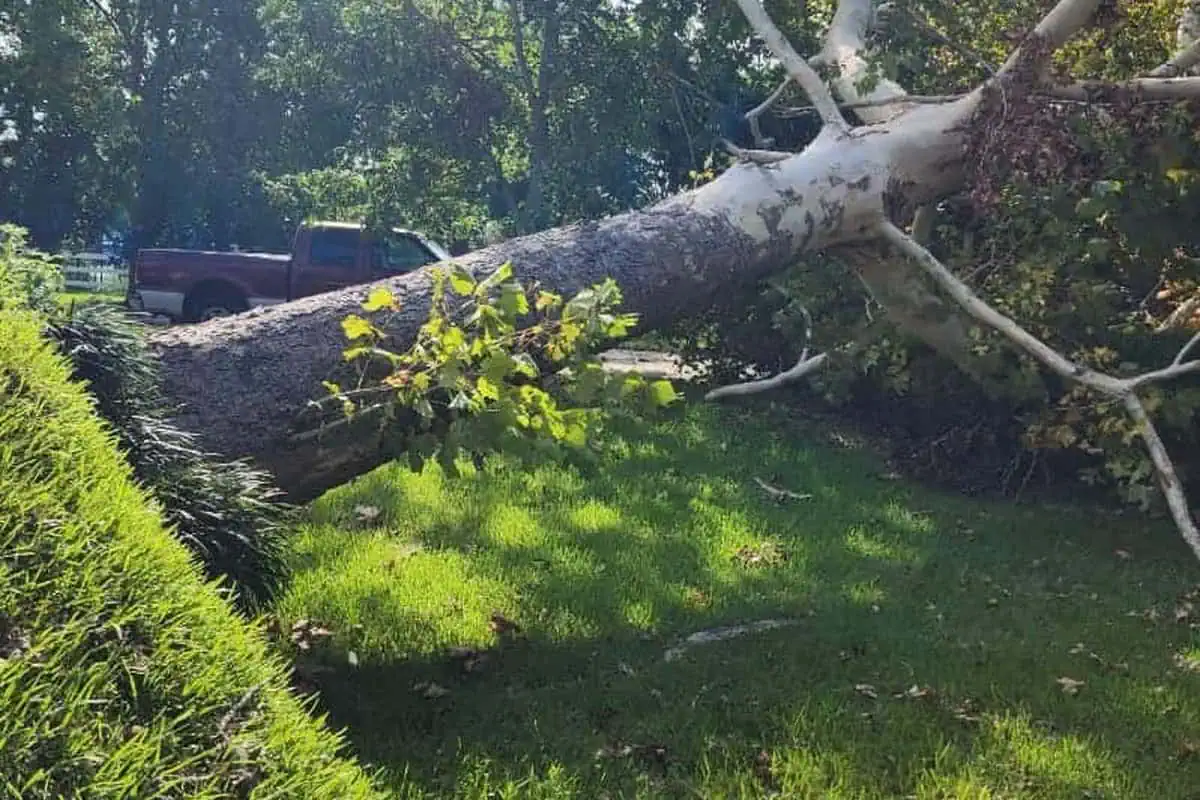
A tree on the roof is not a landscaping problem first. It is a safety problem. If a trunk or a large limb is on your house in Broward, stay out from under it, keep people and pets back, and treat every wire you see as live. KAP Tree Service does storm tree work in Davie after squalls and named storms; the order of operations below is the same whether the tree came down in a thunderstorm or after a hurricane.
Call (754) 291-6477 for a free estimate
Stay away until the scene is safe
Do not walk under a tree that is resting on a roof, a pool cage, or a carport. The load can shift. Do not try to pull limbs off with a truck and a rope. Do not start a chainsaw on a trunk that is bent and storing energy; that is how people get hit when the wood springs.
If anyone is hurt, or you smell gas, or the tree is on a person or a vehicle with people inside, call 911. That is not a tree-service dispatch. Get the emergency response first.
If the house is open to weather, you can tarp from a safe side once the tree is stable and the power is confirmed off. Do not climb onto a wet, loaded roof to “just take a look.”
Downed power lines: call FPL, not a tree guy first
Assume every downed line is energized. FPL’s own safety pages say to stay far away, not to touch or move the line, and to call 911 and FPL at 1-800-4OUTAGE (1-800-468-8243). Their storm guidance is the same: flooded yards and debris piles can hide lines. Read it on FPL’s safety page rather than taking a neighbor’s word that “the line looks dead.”
If the tree is on a service drop to your meter, do not cut it. Tell FPL. A tree company should not drop a limb onto a line or cut a line to “get the tree off.” Once the utility has cleared the wires, the wood is a tree job again.
Keep the driveway clear enough for utility trucks if you can do that without walking toward the wires. Asking a crew a dozen questions on the street slows the restoration for the whole block; FPL says as much on their restoration pages.
Document it for insurance before the saws start
Once you are out of the hazard:
- Photograph the whole tree, the point where it hit the structure, the interior stains or holes, and the street-side context
- Write down the date, the storm name if there was one, and what you heard or saw
- Call your insurance carrier and ask whether they want their own inspector before debris is removed from the structure
- Keep the fallen wood on site if the adjuster asks to see it; we can cut it into sections and stack it
We are not public adjusters and we will not quote a claim number for you. We can give you a written description of the tree, the failure (root plate, broken crotch, dead leader), and the work required to get it off the building. That document is what most homeowners hand the carrier.
If the tree came from the neighbor’s yard, photograph the root plate and the property line. Those disputes get ugly; pictures taken the day of the failure are worth more than a memory in October.
Getting the tree off the house
A tree on a roof is taken apart, not “dropped.” The crew supports the load, cuts in a sequence that lets the house up slowly, and lowers pieces with ropes. The goal is to stop additional puncture to the deck and the cage. After it is off, we can tarp or you can call your roofer; tree work and roofing are different trades, and we will not pretend otherwise.
Access matters. A backyard oak that fell into a lanai in Sunrise is a different setup than a pine across a Davie ranch driveway. Tell us about gates, pool cages, septic lids, and where the wood can be stacked. Hauling and stump grinding are separate line items so you can choose: get the hazard off today, grind later.
Do not hire the first cash crew that knocks after a named storm with no written scope. Ask who is insured, whether they will be on the roof, and whether they will leave the debris. If you want a calmer look at what failing trees look like before the next season, we already published how to prepare trees for hurricane season.
When it is an emergency, and when it can wait until morning
Treat it as urgent if:
- The tree is on the house and the roof is open
- A limb is on a power line, or a line is down (utility first)
- The tree is blocking the only exit from the house
- A split trunk is still hanging and moving
It can often wait until daylight if the tree is in the yard, not on a structure, the power is on, and nobody has to walk under it. Mark it off. Do not let kids treat it as a fort.
We do not advertise a 24-hour crew we cannot staff. If you call the number below, you get a person who can tell you whether we can get there, what to do until then, and whether you should be on the phone with 911 or FPL instead of us.
After the wood is gone, look at the trees that did not fall. A new lean, a heaved root plate, or a cracked crotch on the tree next to the one that failed is the next problem. That is an inspection, not a panic cut.
Call KAP Tree Service at (754) 291-6477 for a free estimate
